
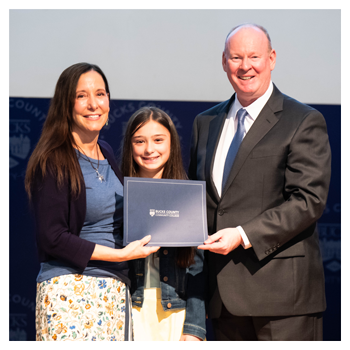
 Professor Spotlight: Mary Dura, Ed.D.
School of Health Professions & Sport Studies
Dr. Mary Dura, who has taught at Bucks County Community College for more than 20 years and worked in nursing for many years before that, has received the prestigious 2026 Lindback Award for Distinguished Teaching. The honor reflects her long-term commitment to high-quality instruction and student success and celebrates teaching that is challenging, clear, and lasting in its effect on a student's worldview. Dr. Dura, who earned her Bachelor of Science in nursing and Master of Science in nursing at Thomas Jefferson University in Philadelphia and her doctorate of education at Delaware Valley University in Doylestown, reflects on the honor, her teaching philosophy, and her favorite Bucks memories.
What was your reaction when you learned you won the 2026 Lindback Award?
I was shocked and deeply humbled by the news. My immediate feeling was gratitude—to my students, colleagues, mentors, family, and the nursing profession itself. Teaching nursing has never felt like simply a job to me. It is a privilege and a responsibility, so to be recognized for something that means so much to me personally was incredibly moving.
One of the most meaningful parts of the celebration was sharing it with my 10-year-old daughter, Julia. She can be a little shy, so I was especially touched when she unexpectedly decided to walk up to the stage with me. Seeing the pride in her eyes made an unforgettable day even more special.
What originally inspired you to move from clinical nursing into higher education?
My path into teaching began unexpectedly while I was in graduate school. One of my professors needed someone to teach a health assessment course and encouraged me to step into the role. What started as an opportunity quickly became a passion.
For many years, I balanced teaching with clinical nursing, which allowed me to bring real-world patient experiences into the classroom. Eventually, I realized that while caring for patients was deeply meaningful, preparing future nurses gave me the opportunity to make an even broader impact through the students I have the privilege to teach.
The Lindback Award is based on nominations from students and colleagues. What feedback has meant the most to you?
Without question, the feedback that means the most is hearing from former students who tell me they felt prepared when caring for patients during difficult moments or that something they learned in class helped them make a safe clinical decision. Nursing is such a human profession, and knowing that students feel more capable, compassionate, and confident in caring for others is deeply rewarding.
At the same time, I was profoundly touched by the generosity and kindness reflected in the comments from colleagues who nominated me. Nursing education is very collaborative, and I have had the privilege of working alongside extraordinary faculty who care deeply about students and support one another.
Ultimately, this recognition feels very shared to me. It reflects the support of wonderful colleagues, the trust of students, and the incredible nursing community at Bucks that works together every day to help students succeed.
Do you have a favorite memory of a student you have impacted?
There are many, but one memory that stands out is of a student who was raising several young children while balancing work, family responsibilities, and significant personal challenges. Like many Bucks faculty members, I met with her often to provide academic support and encouragement. Watching her overcome those obstacles and walk across the stage to receive her nursing pin was an emotional moment I'll never forget.
Experiences like that remind me that nursing education is about much more than mastering medicanl concepts. It's about believing in students and helping them discover what they are capable of achieving.
Nursing school is known for being rigorous. How do you help students succeed?
I try to connect classroom concepts to real patient situations so students understand not only what to do, but why it matters. We use case studies, simulation, guided discussion, and clinical experiences to help students develop critical thinking and clinical judgment.
I also recognize that students learn differently. Some learn best visually, others through discussion or hands-on practice. My goal is to meet students where they are while helping them become safe, confident nurses.
How are you preparing students for the future of healthcare?
Healthcare has become increasingly complex. Today's nurses must be clinically strong, technologically proficient, adaptable, and excellent communicators. Patients are often sicker, healthcare systems move faster, and sound clinical judgment is more important than ever.
Our curriculum emphasizes patient safety, evidence-based practice, communication, prioritization, and collaboration, while helping students become comfortable with technology, simulation, and increasingly complex patient care.
At the same time, one thing has never changed: the importance of compassion and human connection. No matter how healthcare evolves, patients will always need nurses who are knowledgeable, thoughtful, and caring.
What makes Bucks County Community College a special place to teach?
What makes Bucks unique is its sense of community. Our nursing faculty genuinely care about students and about one another. We maintain high standards because nursing demands excellence, but students also know we are invested in their success.
There is a strong culture of mentorship, collaboration, and accessibility. Students are challenged, supported, and encouraged to grow, and I believe that balance helps them develop both confidence and resilience.